
Whatnot Shipping for Sellers, Explained: Who Pays, What It Costs, and Where the Money Leaks
How Whatnot shipping actually works for a US seller in 2026, in plain words: the buyer pays at checkout unless you choose otherwise, the price comes from your listing's packed weight, Ground Advantage is the default at $4.47 to $7.75 for anything under 5 lb, Flat Rate is $12.99 through at least December 9, and Smart Bundling groups a buyer's wins for you. The three settings layers, the Buyer Pays Max trap, the two-business-day rule and the in-app scanner, adjustments and carrier charges, and what to do when a package goes quiet. From Whatnot's help center as of September 29, 2026.
On Whatnot the buyer pays for shipping at checkout, the price comes from your listing’s packed weight, and Whatnot buys the label with that money. When those three line up, shipping costs you nothing. Nearly every shipping complaint in the seller groups is one of them not lining up: the weight was wrong, a cap was set on what the buyer pays, or the package got changed after the sale. Here’s the whole system for a US seller as of September 29, 2026, from Whatnot’s help center, in the order it actually happens.
1. Who pays
By default, buyers pay all shipping. In your show settings you can change that:
- Buyers pay all shipping costs. The default. The buyer sees the cost before bidding and on the receipt.
- Buyer pays up to a set amount. Also called Buyer Pays Max. The buyer is charged at most that amount for the whole show; you cover everything above it.
- Seller pays all shipping. You cover domestic shipping; buyers still pay international.
Shows with the second or third option get a Free Shipping or Reduced Shipping badge in the feed, which buyers can filter for. Two things sellers miss. First, you’re never paid the shipping money: your earnings are the item price after fees, and if the buyer overpaid relative to the label, that difference doesn’t come to you. Second, the payment processing fee is charged on everything the buyer pays, shipping included.
The Buyer Pays Max trap. The max caps the buyer, not the label. Set $7.75 and a buyer’s bundle needs a $20 label, the buyer pays $7.75 and you pay $12.25. A lot of sellers set their max years ago at the old $9.21 flat rate and never looked again. When Whatnot’s rates changed on July 31, 2026, it didn’t change anyone’s max. If you use it, go look at it tonight.
2. Where the price comes from
Three layers, each one able to override the one above it:
- The listing’s shipping profile. Its packed weight, and sometimes dimensions. This is the number everything is worked out from. Shipping profiles explained covers it in full.
- Your default shipping settings in Seller Hub: who pays, which domestic services are on, local pickup, whether custom profiles are used.
- The show’s own settings, which start as a copy of your defaults and can be changed for that show until it starts. Once you’re live, its shipping settings are locked.
Orders placed outside a show ignore your Seller Hub settings entirely and use the listing’s profile plus the cheapest eligible service.
3. What it costs: the US rates
Whatnot buys USPS labels at negotiated rates. Ground Advantage has been the default since July 31, 2026.
| Package | Ground Advantage | Notes |
|---|---|---|
| Up to 4 oz | $4.47 | Weight only, distance doesn’t matter |
| Over 4 oz to 8 oz | $4.85 | |
| Over 8 oz to 12 oz | $5.25 | |
| Over 12 oz to 1 lb | $6.75 | |
| 1 lb to 5 lb | $7.75 | One flat price for the whole band |
| Over 5 lb | Varies | Priced by weight and USPS zone; from about $9.69 |
Each price is the USPS label plus a small operational fee. Shipments to Alaska and Hawaii use standard USPS commercial pricing instead. Boxes over one cubic foot are priced by dimensional weight.
Other services:
- Flat Rate. Turned on in your shipping settings. $12.99 per shipment for anything over 1 lb up to 70 lb, live-show orders only, in USPS Flat Rate packaging. Whatnot is covering part of that price through at least December 9, 2026, and says it will give at least a month’s notice before the price changes. It’s per shipment, not per buyer: a buyer split into two Flat Rate boxes pays twice.
- Priority Mail. Available, about a day faster for some destinations, and in Whatnot’s words usually at least $5 more than Ground Advantage.
- First-Class Mail Letter. The plain-white-envelope option for cards and stickers: $0.78 to $1.39 for up to 5 items and 3 oz, worth up to $20 (Whatnot is testing $50 for some shipments), turned on before the show. Limited tracking, and earnings on the standard timeline start 10 days after the label.
- Media Mail. Whatnot applies it automatically to books, records, CDs, cassettes and movies, as long as Flat Rate is turned off.
Packaging has to match the label. A Ground Advantage label on a Priority or Flat Rate box can bring a USPS fee of about $20 per package, charged to your account, plus delays or a return. Use your own packaging for Ground Advantage.
4. Smart Bundling
When a buyer wins several items, Whatnot groups them into as few shipments as the weight, size and pricing allow. Shipping is charged as each item sells; when an item joins an existing shipment, its shipping is recalculated for the combined box, which is why the second and third wins often add little or nothing. Whatnot’s own example: a 2 lb sweatshirt ships at $7.75; add a 1 lb shirt and a 12 oz hat and the bundle is still under 5 lb, so shipping stays $7.75. Some categories only add an incremental weight per extra item, half an ounce for cards and LEGO, so a buyer who wins ten singles isn’t charged ten times.
Bundling stops in three cases: a custom profile with a max bundle size, purchases from different sales channels (in-show and out-of-show orders don’t bundle automatically), and printing a label, which closes that buyer’s bundle, so anything they buy afterward ships and is charged separately. You can bundle by hand on whatnot.com before the label, and unbundle until the package is in transit, but unbundling is a shipping adjustment and can cost real money. And if you pack two of a buyer’s orders in one box without bundling them in Seller Hub first, the orders can get stuck on Preparing Package, the buyer’s tracking won’t update, and your earnings for those sales are delayed.
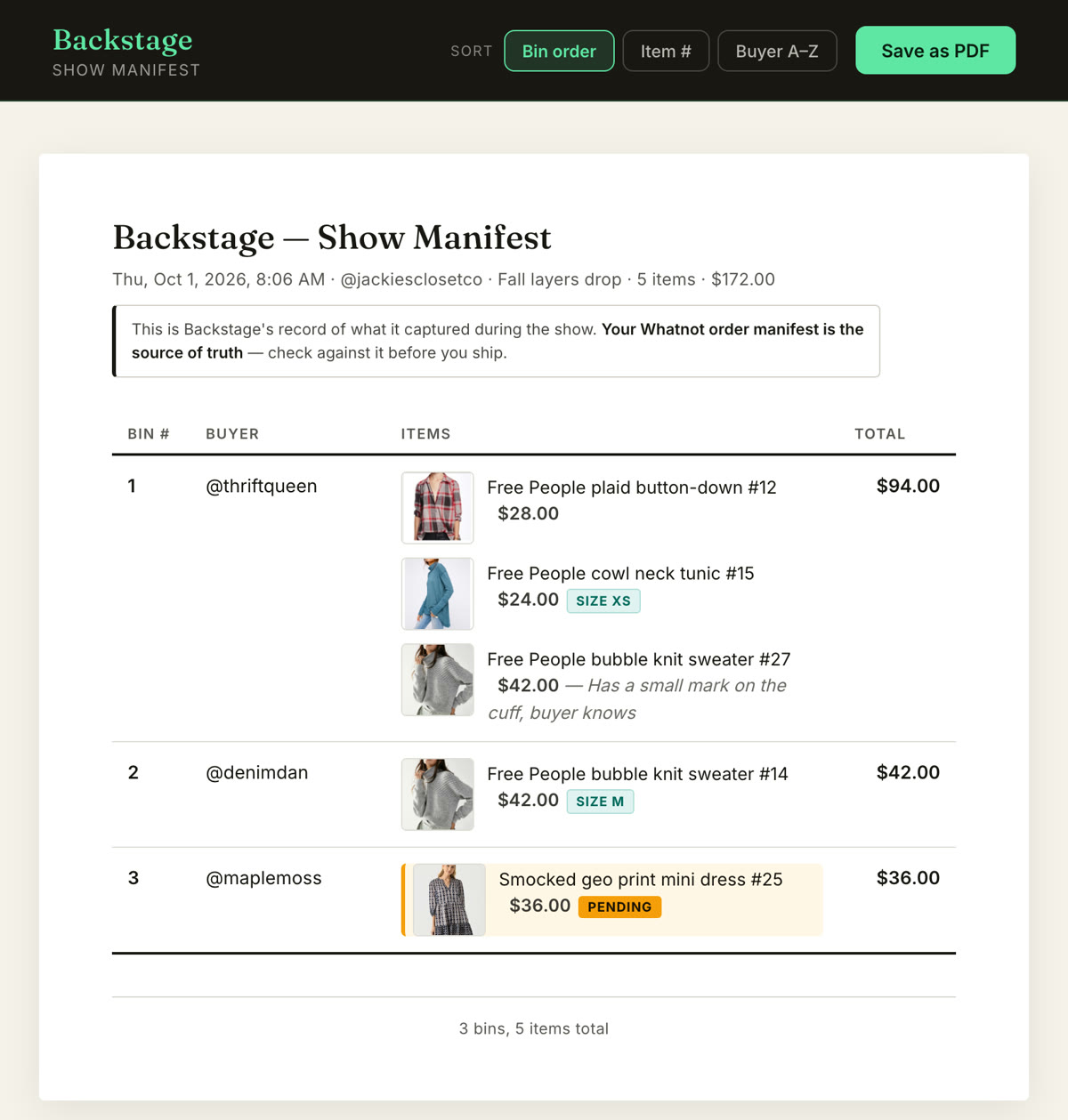
This is where a bin system earns its keep. Backstage puts every win a buyer makes into that buyer’s bin as it happens, so when you open Seller Hub after the show, the shipment Whatnot built and the bin on your table already hold the same things. No hunting, no guessing which of the twelve hoodies was hers.
5. Labels, packing and the two-business-day rule
Labels come from the Shipments page: in bulk on whatnot.com, one at a time in the app, as letter-size PDFs or 4 by 6 for a thermal printer. Whatnot’s packaging guidelines are the usual: sturdy box, about two inches of padding, nothing rattling when shaken, and category rules for cards, comics and Funko. If you don’t own a label printer, you can still ship.
You have two business days from the sale to ship. Shipped means a drop-off scan: carrier acceptance, a kiosk, a USPS SCAN form, or Whatnot’s in-app scanner. Whatnot recommends the scanner because it counts the moment you scan, sends the buyer a photo, and doesn’t depend on the carrier’s first scan, which sellers say can lag for days. Late or unconfirmed shipping lowers your average ship time and on-time scan rate, can get an order cancelled and refunded at your cost, and repeat offenses can cost you Early Payout.
Two business days sounds like plenty until it’s Friday night and there are 80 orders on the floor. The show that ends already sorted by bin is the show that makes Tuesday’s deadline without a Sunday spent matching sticky notes to orders.
6. Adjustments and carrier charges
Change a shipment after the sale, whether weight, size, service or bundling, and it’s a shipping adjustment. US sellers get five free ones a week; some changes are always free, some always charged, and a lighter package is never refunded. Separately, since November 4, 2026, Whatnot bills US sellers for weight-based USPS carrier adjustments on packages shipped from that date, where USPS found the package heavier than the label. Sellers whose first Whatnot sale was on or after September 5, 2026 aren’t included yet. Both are covered in shipping adjustments explained. The prevention is the same for both: an honest packed weight on the listing and a look at the shipment before you print.
7. Delayed, lost and returned
Carrier tracking can take one to three business days to show anything after drop-off. If you confirmed shipment on time, a carrier delay doesn’t count against you. Domestic delivery is usually 5 to 14 business days; message the buyer with the latest tracking, and if it runs long, point them to Get help with this purchase on their order. If Whatnot refunds a verified carrier delay, Whatnot covers the refund. Returned packages have their own help page; contact support so the sale is protected and the item reshipped. Without Early Payout, earnings for a delayed order wait for the delivery scan, which is one more reason payouts feel slow to new sellers.
Where the money leaks, in one list
- A shipping profile lighter than the packed item.
- A Buyer Pays Max set at an old rate.
- Seller-paid shipping on heavy bundles.
- Unbundling a Smart Bundle after the sale.
- Priority or Flat Rate packaging under a Ground Advantage label.
- Packing orders together without bundling them in Seller Hub.
- Not scanning at drop-off, then eating a “late” refund.
Where Backstage fits
Backstage doesn’t run your shipping; Seller Hub does. It works on the two ends of it, which happen to be the two ends where the leaks are. Before the show, Prep lists your items with the shipping profile chosen per item, in Whatnot’s weight bands, so the weight gets set with a scale at your desk. During the show, every sale lands in its buyer’s bin the moment it happens. After the show, the manifest shows every buyer’s items by bin and what each one actually earned after Whatnot’s fees, including the processing fee on shipping, so you can check each shipment against the box before you print and see what the night really cleared. The bin system is what makes those boxes ready the same night, which under Early Payout is also when you get paid.
Next steps
- The number everything is worked out from: Whatnot shipping profiles explained.
- The five free changes and the new USPS charges: Whatnot shipping adjustments explained.
- Weekly bundling for sellers outside the US: Whatnot Weekly Bundling.
Common questions
Who pays for shipping on Whatnot?
The buyer, by default. Shipping is worked out from your listing's packed weight and charged to the buyer at checkout, and Whatnot uses that money to buy the label you print. You can change it per show to Seller pays all, or Buyer pays up to a set amount and you cover the rest. Whatever you pick, you're never paid the shipping money: your payout is the item price after fees. And the processing fee is charged on the whole order, shipping included.
How much does Whatnot shipping cost for sellers?
Nothing directly, when the buyer pays and the label matches the package. USPS Ground Advantage is the default in the US: as of July 31, 2026, $4.47 up to 4 oz, $4.85 up to 8 oz, $5.25 up to 12 oz, $6.75 up to 1 lb, and $7.75 flat for anything from 1 to 5 lb. Over 5 lb it's priced by weight and distance. Flat Rate boxes are $12.99 per shipment through at least December 9, 2026; Whatnot says it will give a month's notice before that changes. Sellers pay when they cover shipping, when they cap what the buyer pays and the real label costs more, when an adjustment moves the package up a tier past their free allowance, or, for packages shipped on or after November 4, 2026, when USPS bills a weight-based carrier adjustment.
What is Buyer Pays Max on Whatnot and why did I get charged?
Buyer Pays Max caps what the buyer is charged for shipping during your show, not what the label costs. Set $7.75 and a buyer's bundle needs a $20 label, they pay $7.75 and you pay $12.25. Sellers who set a max back at the old $9.21 flat rate and then ship heavy bundles on Ground Advantage or Flat Rate are the ones who see charges. Whatnot didn't update anyone's max when rates changed on July 31, 2026; go look at yours.
How does Smart Bundling work on Whatnot?
When the same buyer wins several items in a show, Whatnot groups them into as few shipments as the weight, size and carrier pricing allow, and sometimes splits them when splitting is cheaper. Shipping is charged as each item sells, and when an item joins an existing shipment its shipping is recalculated for the combined package, which is why later wins often show little or no extra shipping. Purchases made in a show and outside a show don't bundle together automatically. If you pack a buyer's orders together, bundle them in Seller Hub first, or the orders can get stuck on Preparing Package and your earnings can be delayed.
How long do Whatnot sellers have to ship?
Two business days from the sale, not counting weekends and holidays. Shipped means a drop-off scan: the carrier's acceptance or kiosk scan, a USPS SCAN form, or Whatnot's in-app scanner, which Whatnot recommends because it credits you the moment you scan instead of waiting on the carrier. Late or unconfirmed shipments hurt your average ship time and on-time scan rate, can lead to a cancellation and refund billed back to you, and repeated late shipping can cost you Early Payout.
What happens if a package I shipped is delayed or lost?
Check tracking from Shipments in Seller Hub; carrier updates can take one to three business days after drop-off. If you confirmed shipment on time, a carrier delay doesn't count against your metrics. Message the buyer with the latest tracking and, if it runs well past the usual 5 to 14 business days, point them to Get help with this purchase on their order. If Whatnot refunds a buyer for a verified carrier delay, Whatnot covers it and you're not billed. Without Early Payout, your earnings for that order wait for the delivery scan.